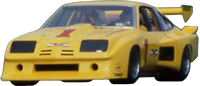
A phase 2 DeKon-Monza (c/n 1005) driver
Allan Moffat in #7 at Bay Park Raceway, New Zealand -
December 28, 1975.
In a February 1976 interview Moffat remarked, “Last
November [1975], at Daytona, I reached the highest speed I have
ever made on a race track - 204 mph, in this very same Monza
I have now. I had gone to the US at the invitation of my old
pal, Horst Kwech, who is actually an expatriate Australian
…”
A phase 2 DeKon-Monza (c/n 1003) driver Al
Unser, Sr. in #4 at IMSA Daytona Finale 250,
Daytona Speedway FL - Nov. 30, 1975.
DeKon was the most successful and
recognized of all the H07 racecar builders, winning
IMSA championships in 1976, 1977, and again in 1978..
Chevrolet had a great deal to do with the design of
the DeKon chassis. General Motors first venture with
CAD drawings was with the DeKon Monza. In late 1974,
DeKon received all of the Monza chassis as complete
cars and reconstructed them as customers ordered
them.
GM built the H07 body Monza from 1975-80,
and it has enjoyed a great run of success in road
racing and many other forms of auto racing. The
Chevrolet Monza was almost exclusively used as the
base to build these racecars. A Pontiac Astre and
Buick Skyhawk were also built for racing.
DeKon Engineering, LTD was formed in July 1974 by
Lee Dykstra and Horst Kwech; the most successful and
recognized of all the H07 racecar builders. The name
DeKon is a concatenation of the D in Dykstra and the
K in Kwech. It is also short for Design and
Construction. DeKon was located in Libertyville,
Illinois. In three years, they produced seventeen
racecars. Of these, fourteen were Monzas.
The cars were designed by Horst Kwech of Ausca
Racing and Lee Dykstra and used to combat the highly
successful Porsches in IMSA (International Motor
Sports Association) competition. General Motors
aided in the project with CAD drawings, their first
attempt at using this technology. Chevrolet had a
great deal to do with the design of the DeKon
chassis. Design/construction was Kwech's group who
actually built the DeKon Monzas and sold them to
customers.
GM started producing Monzas near
the close of 1974 and DeKon received them as
complete cars. They would tear down and reconstruct
them to the needs and specifications of their
customer's.
The Dekon Monza featured a
tubular frame chassis, an overall weight of about
2,400 pounds, and over 600 horsepower from a
fuel-injected V-8 engine. The cars were very fast
and competitive, thanks in part to their excellent
50/50 weight distribution.
Engines used were
heavily modified Chevrolet 5.7-6.0 L V8
small-blocks, normally aspirated, some using four
Weber (2V) downdraft carburetion. They developed as
much as 650 horsepower. The car's lightweight, high
horsepower combination was a formidable competitor
in IMSA and other racing series. After some teething
problems the DeKon Monza of Al Holbert won the IMSA
GT Championship in 1976 and 1977.
These cars mostly ran in IMSA's Camel
GT Challenge Series in the All-American Grand Touring (AAGT)
class from 1975-1986. Also in the
SCCA Trans-Am pro series and its club racing amateur
events.
DeKon Monzas
were built from 1975 to about 1978. Even today,
H07s can be seen racing and winning. Price tag for
a new DeKon Monza was around $38,000, race ready.
Vintage racing is the main attraction for restored
road racing Monzas, but there are a few still
slugging it out in SCCA and NASA race groups. A
fully restored Monza can fetch as much as $268,000,
about seven times the original build price. Not all
DeKon Monzas have a chassis identification plate.
Horst Kwech has been granted 17 patents and is an
active design engineer today.
DeKon chassis
numbers, notes and links
Horst Kwech giving DeKon c/n 1005 a
shakedown at Mid-America in July 1975. Allan Moffat
took ownership five months later.
The first AAGT Monza,
fielded by DeKon Engineering, LTD and driven by
Horst Kwech. White with a thin pin stripe. Crashed,
rebuilt and sold to Carter Chevrolet. Maurice Carter
raced it in IMSA briefly. It's influential impact on
All American GT racing design is still seen on
today's racecars.
Driven by Al Unser for
DeKon Engineering. White with red/blue stripes on
roof. Became Michael Keyser's for 1976 IMSA, scoring
3 victories. Converted to DeKon phase 5 body
for Brad Frisselle and 1977 IMSA rules and entered
in 24 Hours of Le Mans in 1978. Wynn's
sponsored, white, orange, yellow and blue colors.
Preserved in Frisselle form for Historic Sportscar
Racing as of 2010.
Tom Franks IMSA and
SCCA T/A CAT.II Monza 1977-78. White with green
stripes. DeKon Phase 4 then updated to phase 5 body.
Still in original form as a vintage racer.
Alan Moffat's 1976-77
Australian GT Championship Monza. DeKon Phase 3
body. White with red/blue stripes on top of car.
Currently under restoration in the US.
Michael Keyser's
1976-77 IMSA Monza. White with red/blue stripes on
top of car and had a Lola Can-Am rear wing. DeKon
Phase 4 body. Entered in the 1976 24 Hours of Le
Mans. Roy Woods installed a twin-turbo V8 in
it and campaigned it in IMSA and SCCA T/A CAT.II
from 1977-81, painted all yellow. Currently under
restoration in the US.
Jerry Jolly's IMSA and
T/A CAT.II Monza. Orange with blue/yellow
pinstripes. DeKon Phase 3 body. Restored and
currently campaigned in vintage racing by Steve
Walker on the west coast.
Al Holbert's 1976
effort scored 7 victories and won 1976 IMSA AA/GT
championship. Phase 3 body style, blue and
yellow with red accents. Scored first IMSA win for a
Monza at Road Atlanta in '76. Then owned by John
Paul competed in 1977 IMSA races. Painted light blue
and yellow. Updated to Phase 5 body with rear
"banana" wing. Purchased by Floridian Joe Gonzalez
and campaigned in IMSA GTO throughout 1980's. Sold
to private collection in New York.
Greg Picket's '77
effort, mostly for Trans-Am (Cat.II) and IMSA GT.
White with yellow and red diagonal paint scheme.
DeKon Phase 4 body with rear banana wing.
Chris Cord's '77-81
IMSA racecar. Red w/ Budweiser sponsorship. DeKon
Phase 5 body and wing. Had the most radical bodywork
seen on a Monza in 1980-81. Last of the "TRUE" IMSA
AA/GT cars. Presumably owned by Ken Epsman,
ownership history uncertain.
Originally built for
Ted Fields' Interscope Racing team, raced twice by
Danny Ongais. Second car for Chris Cord Racing with
co-driver Jim Adams for IMSA 1980-81. Livery similar
to DeKon 1011, red with Budweiser sponsorship.
Rebuilt as a GTP
attempt in the early 1980's by CCR. Donated to
museum in Las Vegas and sat for many years.
Presumably purchased in 2005 by Ken Epsman ownership
history uncertain. Restored to IMSA AA/GT
configuration for HSR.
Al Holbert's 1977
effort. Won the 1977 IMSA AA/GT championship,
including four victories. Phase 5 body style, blue
and yellow with red accents.
(Same
color as c/n 1008.) David Heinz bought car for
selected IMSA races in 1978-79. Red and white with
Budweiser sponsorship. Sold in 1979 to South
American team. Might have been privately raced in
IMSA GTO. Currently in private collection in
New York.
1015
A
Buick Skyhawk built for Gene Felton and IMSA
Champion Spark Plug Challenge.
Built for Keith Feldott
and SCCA A-Sedan effort. Rebuilt by Dan Gallant
after serious crash. Campaigned in IMSA GTO and SCCA
T-A, 1979-85. Restored and raced by Pleasant
Lake Motorsports in SCCA Club Racing GT-1 class in
1994-97. Privately owned and raced in vintage class.
1017
A
Camaro built for S. Burgess as a circle-track
racecar.
1018
Built for Al Holbert's
1978 IMSA effort, but never raced. The only DeKon
Monza designed with a trans-axle and big block
aluminum "Can-Am" engine. Currently in private
collection in New York.
Body Style Phases
Monza build description by DeKon
Engineering, Ltd.
Phase 1
1974 prototype/concept
body was similar to the 1977 Chevrolet
Monza Mirage special edition. Mild "COKE
Bottle" style shaped body flares with
wrap-around rear spoiler. Non-scooped
front air dam. Hood had half-length
bulge to clear downdraft carburetors or
fuel injection systems.
Phase 2
The 1975 and early 1976
body added wider body flares and scooped
door extensions.
Phase 3
Used most of 1976 IMSA
season and SCCA Trans-Am 1980-onward.
Wider body flares. Slightly taller
wrap-around rear spoiler. Non-scooped
front air dam with rubber skirting.
Scooped door extensions. Hood had a
full-length bulge for fuel system.
Phase 4
Used in 1977 season.
Widest available body flares, Phase-3
rear spoiler but with large "banana"
style rear wing. Scooped front air dam.
Several different style door extensions
seen; scooped, non-scooped, NACA duct or
slotted. Brad Frisselle utilized a flat
ramp style front air dam. Hood had a 2"
full-length bulge.
Phase 5
No wrap-around rear
spoiler, only large "banana" style rear
wing in various forms. Larger front cow
catcher air dam, several variations.
Different styled door extensions seen.
Hood had a long, 3" bulge.
Monzas on Parade...
The 1975 Dekon-Monza
1975 Dekon (c/n 1002) first owner Harry
Theodoracopulos #21
SCCA Trans-Am at Pocono Int'l Raceway in
Long Pond, PA - May 9, 1976
1975 Dekon Monza (c/n 1002) Harry Theodoracopulos'
old car. Driven by Chad Raynal #21 at Monterey
Historic Automobile Races (MHAR) Laguna Seca Raceway, CA -
August 2009.
The second DeKon Monza All-American GT (AA/GT) chassis built
was #1002. DeKon Engineering built this vehicle for Harry
Theodoracopulos. "Harry T" ended up wrecking the
vehicle during his first practice session and sent the car
back to Dekon, where it was repaired and updated. One
of the updates the car got was an extra bar, running from
the main roll hoop, and down to the passenger foot well
area. They named this extra bar the 'Harry bar,' because
they were worried he'd need the extra bracing for his next
big wreck.
In 1975 and 1976, Harry T, ran his car (c/n 1002) in IMSA GT
events at Lime Rock, Sebring and Road Atlanta. He also
entered the car in both the Watkins Glen and Pocono SCCA
Trans-Am events in 1976.
In 1978, William Wonder purchased and raced the car in IMSA.
It remained in William Wonder's possession until the late
1980s and has since been vintage raced.
Specifications 1975 Series
Tuner
DeKon
Chassis Number
1002
Engine Location
Front
Drive Type
Rear Wheel
Production Years for Series
1975 - 1980
Weight
2400 lbs (1088.6 kg)
Engine Configuration-Cylinders
V-8
Aspiration/Induction
Normal
Displacement
4927.00 cc | 300.7 cu in. | 4.9 L
Horsepower
650.00 HP (478.4 KW)
Torque
556.00 Ft-Lbs (753.9 NM)
HP / Liter
132.7 BHP / Liter
Fuel Feed
Fuel Injected
Transmission
Manual
Gears
4
The 1976 Dekon-Monza
1976 DeKon-Monza (c/n 1007) Phase-3, Jerry
Jolly #3 "Spirit of Colorado/KLZ Radio" during Shasta
Monterey Grand Prix at Laguna Seca 100 - October 3, 1976
Gerry Wellik became the second owner.
1976 DeKon-Monza (c/n 1007) Phase-4, Steve
Walker #107 at MHAR Laguna Seca Raceway, August 2009.
First owned by Jerry Jolly then by Gerry Wellik.
This 1976 Dekon Monza, red #107 (c/n 1007) is
thought to be one of the most original Dekon Monzas in this
country. It was driven by Jerry Jolly in the IMSA Camel GT
Circuit in 1976, 1977 and 1978. It was later raced in the
Trans Am Series by Gerry Wellik, Jerry Hansen and Doug
Ripple from 1979 through the early 1980's. The car was
placed in storage for 20 years and was found by the current
owner in 2002. It is currently raced in Southern
California vintage events. This car is powered by an
eight-cylinder engine capable of producing 600 horsepower
and 550 foot-pounds of torque.
Specifications 1976 Series
Tuner
DeKon
Chassis Number
1007
Engine Location
Front
Drive Type
Rear Wheel
Production Years for Series
1975 - 1980
Engine Configuration-Cylinders
V-8
Aspiration/Induction
Normal
Displacement
5750.00 cc | 350.9 cu in. | 5.8 L.
Horsepower
600 BHP @ 7200.00 RPM
Torque
550.00 Ft-Lbs (745.8 NM)
HP / Liter
103.4 BHP / Liter
Fuel Feed
Fuel Injected
Transmission
Manual
Gears
4
Tale of two Monzas, driver Al Holbert
#14 DeKon (c/n 1008) Phase-3, chased by Michael Keyser
#1 DeKon (c/n 1003). Here, Keyser won the IMSA Daytona
Finale 250 on Nov. 28, 1976.
For 1976, a new engine supplier was found and several new
chassis had been built and sold to different teams. It
seemed that it would be the perfect year to demonstrate the
Dekon cars real potential.
Al Holberthad taken delivery of his
new car and Michael Keyser
had purchased one. They won seven of the fifteen races they
entered and Al Holbert won the 1976 title. In 1977, he would
do it again facing a stronger opposition. Porsche was
allowed to run its 934s and BMW had entered a fantastic 320
Turbo in the capable hands of
David Hobbs that proved fast, if not always
reliable.
Al Holbert had
developed his car, now displaying a big rear "banana" wing
and the car proved even more effective. Unfortunately, it
was to be the last IMSA title for a
Dekon Monza, as in
1978, the rules would allow Porsche 935s, cars that would
dominate the series for a while. Monzas would still be seen
on the Camel GT circuit, but would never win a race anymore.
1976 DeKon-Monza (c/n 1011) Phase-5, driver
Chris Cord #19 at
IMSA Camel GT/World Sports Car Championship, a 6 hour
endurance race at Riverside Int'l Raceway, CA on April 26,
1981
Chris Cord's 1980 season body
work would be the most radically styled "PHASE"
seen. He took a Phase 5 body, then cut large
slotted openings on either side of the long 3"
hood tunnel/bulge to serve as exits for the
radiator-cooled air. This diverted heat away
from the engine and helped to create a "suction"
effect under the car for better handling. The
hood tunnel was very tall to clear the four
down-draft carbs. The rear of the hood matched
the angle of the sloped windshield, and sat just
a few inches from it. The door extensions had
large scoops for side mounted oil coolers. Each
rear fender had a large slotted opening on top
to serve as an exit for the side-mounted
radiator-cooled air. Rear wheels were 19" tall,
the largest ever seen on a Monza.
Three decades later, one of Chris Cord
Racing's two Monzas.
1976 Dekon Monza (unconfirmed as c/n
1012) Phase-5,
driver Ken Epsman #20 at MHAR Laguna Seca, CA August
2009.
On board a 1976 Dekon Monza,
owned and driven by Ken Epsman #20.
Vintage IMSA/GTO race at Monterey
Historic Automobile Races. Laguna Seca, CA -
August 16, 2009.
The 1977 Dekon-Monza
DeKon-Monza (c/n 1004) Phase-5, driver
Tom Frank #24, finished 4th at Mid-Ohio -June 5,
1977. Car with updated 'cow catcher' front air dam.
(Again, 30 years previous to same chassis above.)
DeKon-Monza (c/n 1004) Phase-5, formerly
owned by Tom Frank
34 years later on display at Canepa Scotts
Valley, CA in 2011
This was the last year DeKon Engineering Ltd.
produced the Monza GT racer. The most identifiable
feature in '77 was a redesigned front air dam, referred to
as a "cow catcher", with vertical strut bracing. The
cars were becoming technically dated and outperformed by
newer Trans-Am and IMSA GT entrants.
Tom Frank drove c/n 1004 from 1976 through
1979 at such events as the Road Atlanta 100 "WQXI Camel GT"
IMSA race on April 17, 1977. He was 5th on the grid,
finishing in the same position that day. The sponsor
for the white/green #24 Monza was "Executive/Huffaker."
Specifications 1977 Series
Tuner
DeKon
Chassis Number
1004
Engine Location
Front
Drive Type
Rear Wheel
Production Years for Series
1975 - 1980
Engine Configuration-Cylinders
V-8
Cylinders
8
Aspiration/Induction
Normal
Displacement
5750.00 cc | 350.9 cu in. | 5.8 L.
Horsepower
600 BHP @ 7200.00 RPM
Torque
550.00 Ft-Lbs (745.8 NM)
HP / Liter
103.4 BHP / Liter
Fuel Feed
Kinsler
Fuel Injection
Transmission
Manual
Gears
4
Racing Series and Sanctioning Bodies
Clubs and organizations where Monza racecars
ran
The International Motor Sports
Association (IMSA) is an American road racing
organization and sanctioning body based in
Braselton, Georgia. It was started by John
Bishop, a formerly of SCCA, and his wife Peggy
in 1969 with help from Bill France, Sr. of
NASCAR. Camel cigarettes was the title
sponsor for the IMSA racing series known as,
"Camel GT Challenge Series," from about 1975
-1984.
The Sports Car Club of America (SCCA) is a club and
sanctioning body supporting road racing, rallying, and
autocross in the United States. Formed in 1944, it runs many
programs for both amateur and professional racers.
The Trans-Am Series dates back to its first season in 1966.
From 1966-1970, this professional racing series held a
Championship to crown a Manufacturers' Champion. In 1971, a
Drivers' Championship was formally adopted, with both
Drivers' and Manufacturers' Championships being awarded
through the 2005 season. The series was split into two
classes from 1976-1979, crowning Champions in each division.
SCCA both owned and operated the Trans-Am Series, either
internally or through its SCCA Pro Racing subsidiary, from
1966 through 2000. In 2001, SCCA began a series of outside
licensing agreements for the series from 2001-2006. In its
41 seasons, the series held 446 separate races. Throughout
the years, some of the greatest names in motorsports have
participated in the Trans-Am Series. Backdating the Drivers'
Championship to the inaugural season, 30 different drivers
took titles, with multiple Championships being won by Paul
Gentilozzi, Tommy Kendall, Mark Donohue, Scott Pruett, Wally
Dallenbach Jr., George Follmer, Peter Gregg, Horst Kwech,
Scott Sharp and Bob Tullius.
As of 2011, Trans-Am allows Club
Racing's GT-1, GT-2, GT-3 and GT-L class
regulations, giving amateur drivers a chance to
race professionally.
Club Racing is the foundation from which SCCA
built itself when it formed in 1944. Most of the
participants in SCCA's Club Racing program are unpaid
amateurs, but some go on to professional racing careers. The
club is also the source for race workers in all specialties.
As racing technology improved, it was hard for the tube
frame Monza to keep pace with in professional racing
programs. Monzas descended into the amateur ranks of this
program, but one was built especially for its American Sedan
(AS) class.
Historic Sportscar Racing (HSR) is one of several vintage
racing clubs in existence. Historic racing series such
as HSR represent the fastest growing segment of motorsports
in the United States and Europe. Fans flock to see historic
racecars compete as they did on road racing circuits decades
ago. Today, there are still a few original tube frame
Monzas gracing the track with their chest thumping sound.
SCCA Trans-Am Series and Sponsor
Logos
You will find these decals and others on
racecars from this period